
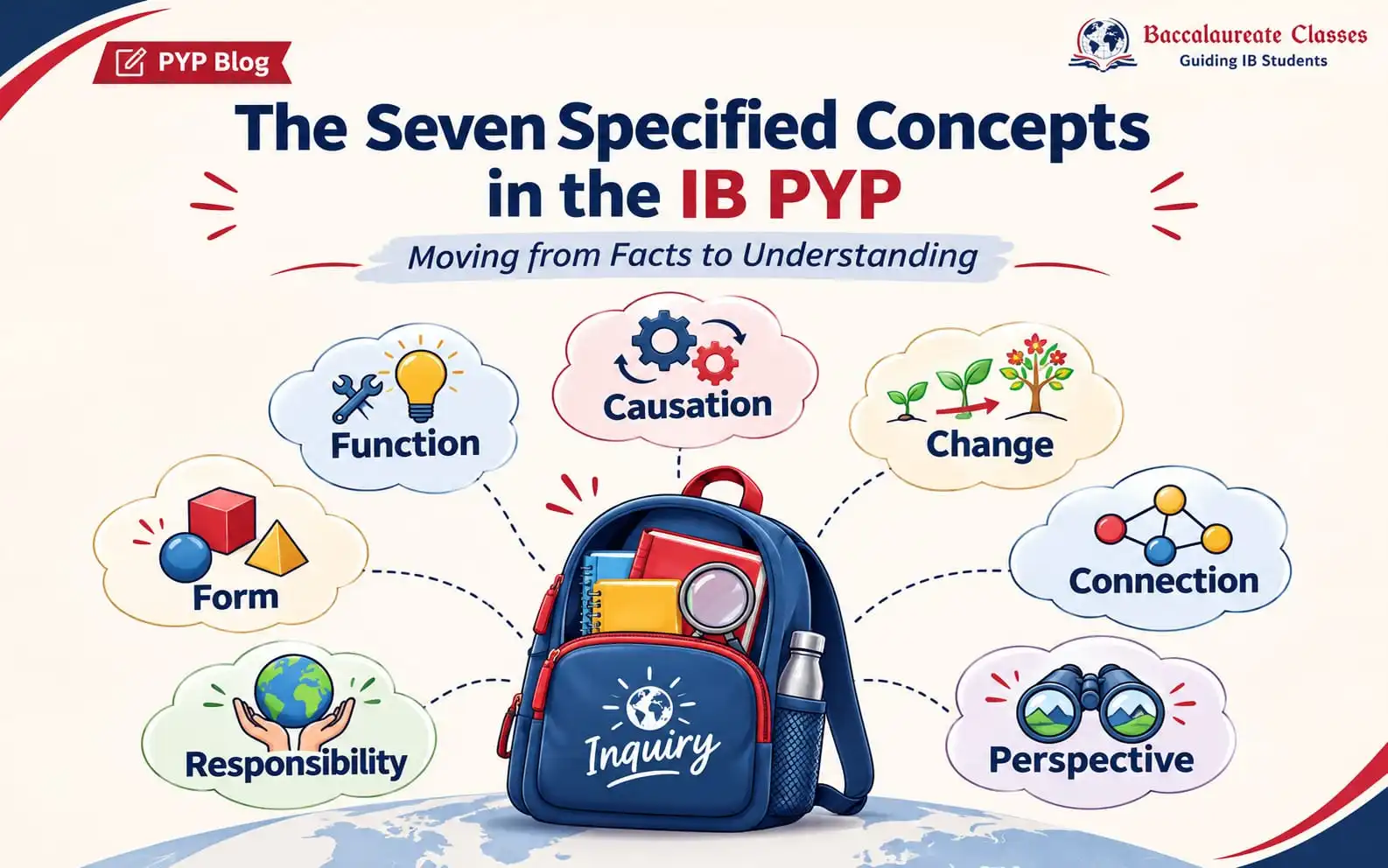
What if a school backpack could teach a child about the world?
Imagine a teacher placing an ordinary backpack in the middle of a classroom and asking, “What can we learn from this?”
One child examines its materials. Another wonders why it has adjustable straps. A third questions where it was manufactured, while another considers what happens when it is discarded.
Suddenly, an everyday object becomes a starting point for exploring Science, Mathematics, design, sustainability and human behaviour.
This is the power of the IB PYP key concepts, known as specified concepts within the International Baccalaureate Primary Years Programme (IB PYP). These conceptual lenses encourage learners to move beyond factual knowledge towards deeper understanding, meaningful connections and independent thinking.
1. Why does conceptual understanding matter in the IB PYP?
Imagine a child who can identify and label every part of a plant. Now introduce an unfamiliar plant growing in a desert and ask why its leaves look different.
Can the child apply previous knowledge to explain this unfamiliar situation?
Conceptual understanding enables learners to recognise relationships and apply their knowledge across different contexts. This process is known as transfer of learning.
The seven specified concepts provide different lenses through which learners can investigate the world. Rather than treating them as definitions to memorise, the PYP encourages children to use them as tools for questioning, reasoning and discovery.
2. Seven concepts, one backpack: an inquiry in action
Let us return to our classroom backpack and explore how each specified concept creates a different learning opportunity.
Form — What is it like?
Children observe the backpack's shape, size, texture, materials and compartments. They might compare a canvas backpack with a waterproof one or identify geometric shapes within its design.
Inquiry question: How do backpacks differ in their characteristics and structure?
Through observation, comparison and classification, learners develop an understanding of properties and characteristics.
This conceptual lens can also be applied when investigating animal adaptations, architectural structures or mathematical shapes.
Function — How does it work?
Why does a backpack have adjustable straps, separate compartments and different fasteners?
Children investigate how these features help the backpack fulfil its purpose. They might design a bag for a particular user and justify their choices.
Inquiry question: How does the design of an object influence its usefulness?
Learners recognise relationships between structure and function, an understanding they can transfer to plant roots, bridges, body systems and technological inventions.
Causation — Why is it like this?
Imagine discovering that the backpack's zip no longer works.
Could trapped fabric, repeated use or manufacturing quality explain the problem? Children investigate possibilities rather than immediately accepting an assumption.
Inquiry question: What factors influence the durability of everyday objects?
Learners develop critical thinking by considering causes, consequences and supporting evidence.
The same reasoning can help them investigate why plants wilt, why communities experience flooding or why historical events occur.
Change — How is it changing?
Invite children to compare school bags used by their grandparents with contemporary backpacks.
How have materials, designs and features evolved? What might school bags look like in the future?
Inquiry question: How do changing human needs influence product design?
Learners explore transformation, innovation and continuity. They can transfer this understanding to inquiries about transportation, communication, technology and communities.
Connection — How is it connected to other things?
A backpack may connect cotton farmers, textile manufacturers, designers, transport networks, retailers and consumers.
Children could investigate its journey from raw materials to the finished product.
Inquiry question: How does an everyday object connect people, places and resources?
Learners recognise interdependence and interconnected systems while making meaningful connections between Geography, Science, Mathematics and Social Studies.
Perspective — What are the points of view?
Present the same backpack to a student, parent, designer and environmental advocate.
A student might prioritise appearance, a parent affordability, a designer functionality and an environmental advocate sustainability.
Inquiry question: Why might different people have different priorities when choosing the same product?
Learners explore how experiences, roles and values influence viewpoints. They practise open-mindedness by listening respectfully and considering alternative interpretations.
Responsibility — What choices can we make?
What happens when a backpack is no longer needed? Could it be repaired, reused or donated instead of being discarded?
Children might investigate how everyday decisions contribute to waste and identify ways to extend the usefulness of products.
Inquiry question: How can responsible choices reduce unnecessary waste?
Through reflection and informed decision-making, learners connect conceptual understanding with meaningful action.
3. How do specified concepts connect learning across subjects?
The backpack investigation demonstrates how conceptual inquiry can extend beyond traditional subject boundaries.
In Mathematics, learners could compare dimensions, capacity and prices. In Science, they might investigate material properties. Language learning could involve writing product descriptions or persuasive arguments, while Social Studies introduces manufacturing, trade and consumer choices.
Throughout these experiences, children develop Approaches to Learning (ATL) skills, including research, thinking, communication and social skills.
They demonstrate IB Learner Profile attributes by becoming inquirers, thinkers, open-minded and principled learners.
Importantly, not every Unit of Inquiry needs to address all seven concepts. Teachers select conceptual lenses that meaningfully support the intended understanding.
4. How can parents encourage conceptual thinking at home?
Conceptual learning does not require elaborate resources. Everyday experiences offer valuable opportunities for inquiry.
During a supermarket visit, ask why products use different packaging. This encourages thinking through Function.
While reading a story, explore why characters interpret the same situation differently. This introduces Perspective.
When examining old family photographs, discuss how neighbourhoods have developed over time. This brings Change into the conversation.
Rather than providing immediate explanations, encourage children to justify their thinking, explore possibilities and make connections.
Asking “Where else could this understanding apply?” can reveal whether a child is beginning to transfer learning independently.
5. How Baccalaureate Classes supports conceptual learning
Some children confidently identify concepts but experience difficulty applying them to unfamiliar situations.
For example, a learner might explain Causation accurately but struggle to investigate why a plant is not growing well.
An IB PYP tutor can scaffold this thinking through guided questioning, visual organisers and evidence-based reasoning. The learner can then apply the same conceptual lens independently to a different situation.
Through personalised online PYP tuition, Baccalaureate Classes can complement classroom learning by strengthening subject knowledge, conceptual connections and independent thinking.
The objective is not to provide ready-made answers but to help children develop their own explanations and increasingly take ownership of learning.
Frequently asked questions
1. Are specified concepts and key concepts the same?
Key concepts is a familiar term in PYP discussions. Specified concepts is the terminology used in current PYP materials for these seven conceptual lenses.
2. Does conceptual learning replace factual knowledge?
No. Factual knowledge provides the foundation, while conceptual understanding helps learners interpret and apply that knowledge meaningfully.
3. Can concepts be explored across different subjects?
Yes. Connection, for example, can be explored through food chains, mathematical relationships and interactions between characters in literature.
The next time your child picks up an ordinary object, consider asking:
“What can this teach us about something much bigger?”
Meaningful learning is not always about discovering something new. Sometimes, it is about discovering new ways to understand something familiar.
Explore personalised online IB tutoring at Baccalaureate Classes to support your child's curiosity, conceptual understanding and independent learning.
Visit www.baccalaureateclass.com to learn more.