
Choose your course, understand the papers and prepare with the right calculator. Compare current and revised IB DP mathematics in one practical guide for students and parents.
At Baccalaureate Classes, we help families connect course choice with university plans, mathematical readiness and school assessments. Our founder, Nishit Kumar, has tutored IB DP Mathematics and Physics full time since 2012.
Know your assessment cohort. Current syllabus: final assessment November 2028. Revised AA and AI: first teaching August 2027 and first assessment May 2029. Your examination session determines which requirements apply.
Compare the four IB DP mathematics courses
Students take one mathematics course for the Diploma. Both pathways include algebra, functions, geometry, statistics, probability and calculus; their emphasis and depth differ.
AA means Analysis and Approaches; AI means Applications and Interpretation. SL means Standard Level and HL means Higher Level.
| Course | Learning emphasis | A useful readiness question |
|---|---|---|
| AA SL | Algebraic reasoning, functions and calculus | Can I explain methods and work accurately without a calculator? |
| AA HL | Deeper analysis, proof and demanding multistep problems | Do I enjoy unfamiliar questions and sustained symbolic work? |
| AI SL | Modelling, statistics and mathematics in practical contexts | Can I interpret data and explain what a result means? |
| AI HL | Advanced modelling, statistics and technology-assisted analysis | Can I combine strong mathematics with critical interpretation? |
AA is not only pure mathematics. AI is not only statistics. Both demand reasoning, communication and independent practice. AI HL requires strong algebra, critical interpretation and sustained independent practice.
Make the comparison concrete
| Same situation | AA emphasis | AI emphasis |
|---|---|---|
| A changing population | Analyse a function and justify its mathematical behaviour | Fit a model, evaluate assumptions and interpret predictions |
This is an illustration of emphasis, not an exclusive topic split. Explore our IB Maths Analysis and Approaches (AA) Tutor and IB Maths Applications and Interpretation pages for course-specific support.
Choose AA or AI with university requirements first
Begin with possible degrees and the school's available courses. A label such as economics or business is too broad to determine the pathway. If degree plans are undecided, shortlist likely routes before narrowing the options.
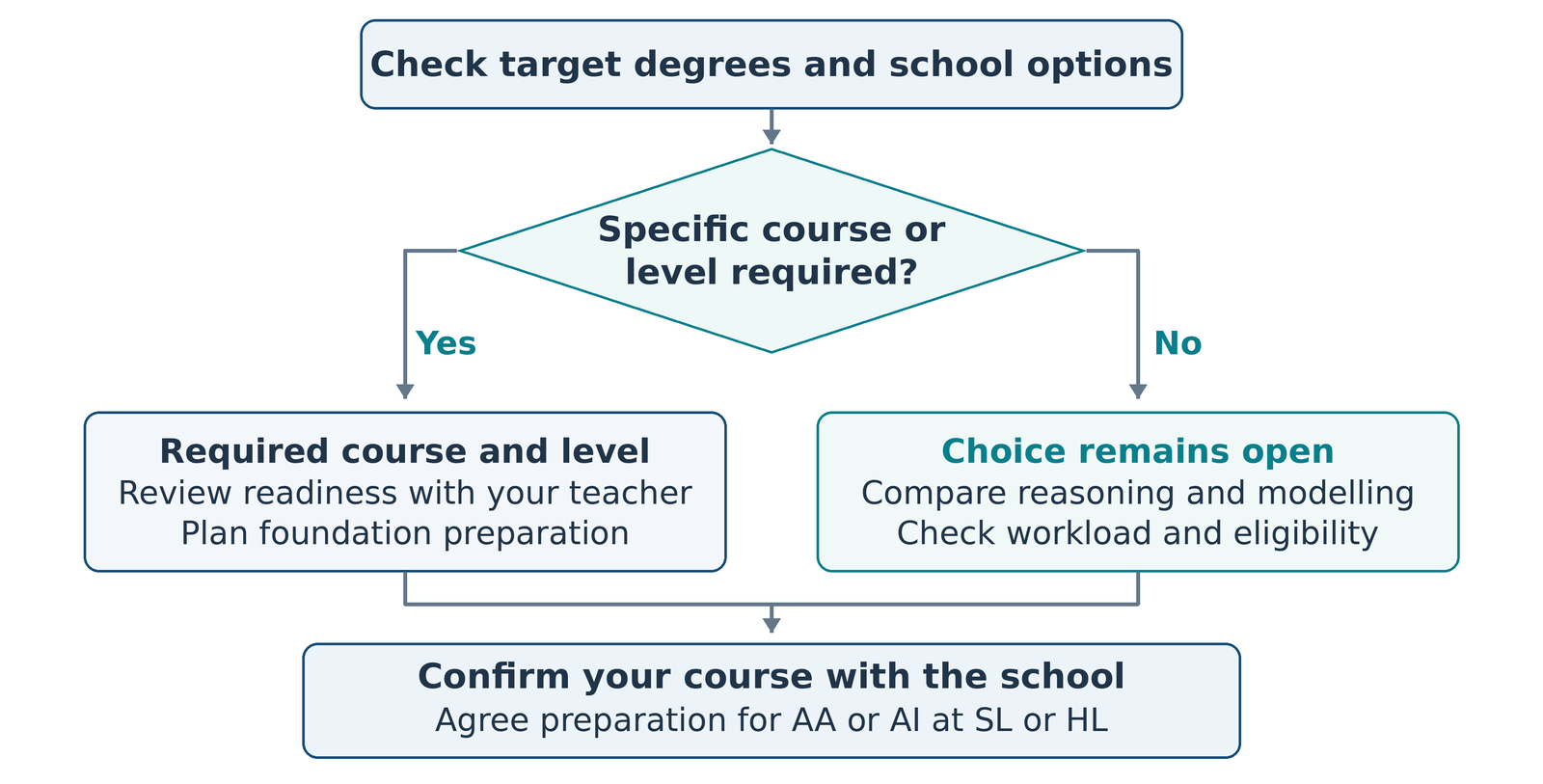
| Check | Why it matters |
|---|---|
| Required pathway and level | A high grade in an unaccepted course does not replace a prerequisite. |
| Required grade and entry year | Requirements can change; check the intended intake. |
| School provision | Availability and timetabling affect the practical options. |
Real examples: LSE's BSc Mathematics with Economics currently requires grade 7 in AA HL. Oxford accepts either pathway at HL for courses requiring mathematics, with a separate arrangement for Chemistry. Check each degree directly.
Select HL or SL with readiness and workload in view
| Factor | SL | HL |
|---|---|---|
| School teaching recommendation | 150 hours | 240 hours |
| Academic demand | Course foundations with less breadth | Greater breadth, depth and unfamiliar problem-solving |
| Decision test | Does SL meet my degree requirements? | Do I need HL and can I sustain the workload? |
Teaching hours are IB school recommendations, not tutoring hours or total study time.
Ask the teacher to review recent work for accurate algebra, graph interpretation and independent problem-solving. A student who succeeds only on familiar exercises needs preparation for unfamiliar HL questions. Agree a realistic study routine across all six Diploma subjects; a course choice should fit both future plans and present readiness.
Understand the current IB Maths examination pattern
Current syllabus through November 2028. The following applies to both AA and AI for duration, marks and weighting. Paper formats and calculator rules differ by pathway.
| Level | Paper 1 | Paper 2 | Paper 3 | IA |
|---|---|---|---|---|
| SL | 90 min 80 marks 40% | 90 min 80 marks 40% | Not taken | 20% |
| HL | 120 min 110 marks 30% | 120 min 110 marks 30% | 75 min 55 marks 20% | 20% |
| Pathway | Paper 1 | Paper 2 | HL Paper 3 |
|---|---|---|---|
| AA | No calculator; short-response and extended-response sections | GDC required; short-response and extended-response sections | GDC required; two extended-response problem-solving questions |
| AI | GDC required; short-response questions | GDC required; extended-response questions | GDC required; two extended-response problem-solving questions |
All questions are compulsory. SL students sit two papers; HL students sit three. A formula booklet is provided, but choosing a method and showing reasoning remain the student's responsibility.
Compare the examination pattern for first assessment 2029
| Level | Paper 1 | Paper 2 | Paper 3 | IA |
|---|---|---|---|---|
| SL | 90 min 75 marks 40% | 90 min 75 marks 40% | Not taken | 20% |
| HL | 120 min 100 marks 30% | 120 min 100 marks 30% | 60 min 50 marks 20% | 20% |
AA retains a non-calculator Paper 1. AI requires technology on every paper. The question-format distinction shown above remains in the revised briefs. External examinations still contribute 80% and the exploration 20%.
Prepare for your own session. Practise the appropriate timing and mark allocation. Fewer marks do not establish that the revised exams will be easier. Current HL Paper 3 is 75 minutes; the 2029 version is 60 minutes. Use updated guidance rather than older summary sheets.
Our Online IB Maths Tutoring connects topic practice with the paper being prepared for: exact working in AA Paper 1, efficient GDC use in technology papers and sustained reasoning in HL Paper 3.
See what changes in the AA and AI syllabus for 2029
The revised courses retain AA and AI at both levels. The IB describes targeted content reductions with no new content added. These are selected published removals, not a replacement for the complete course guide.
| Route | Published removals |
|---|---|
| AA SL | Financial applications and bivariate data |
| AA HL | Financial applications, proof by counterexample, bivariate data and Euler's method |
| AI SL | Logarithms and approximation of areas using the trapezoidal rule |
| AI HL | Complex numbers, vector product, Poisson distribution and specified hypothesis tests for a normal population mean, a Poisson population mean and the correlation coefficient |
Calculus remains in AI and probability and statistics remain in AA. A topic removed from an examination syllabus may still have value in a student's broader mathematical learning.
Match Maths IA guidance to the correct assessment cohort
The IB Maths Internal Assessment (IA) is compulsory in all four courses and contributes 20%. It is assessed by the school and moderated by the IB.
| Current IA | IA for first assessment 2029 |
|---|---|
| Five criteria: Presentation, Mathematical communication, Personal engagement, Reflection and Use of mathematics. The Use of mathematics descriptors differ between SL and HL. | Four criteria: Problem specification (4), Abstraction (6), Computation (4) and Interpretation (6). Total: 20 marks. The revised criteria apply at SL and HL. |
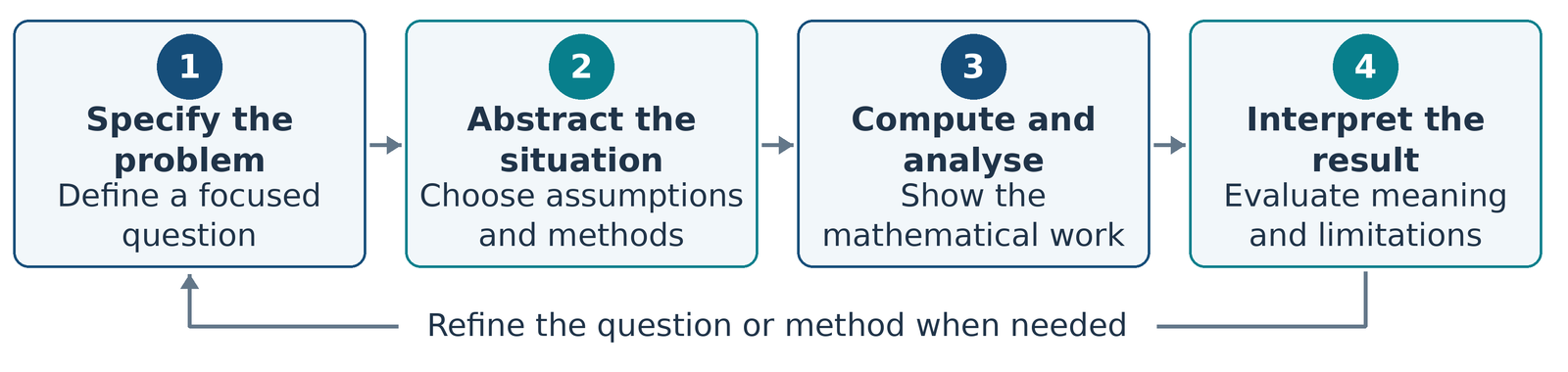
A practical IA test: Can the student explain the question, justify assumptions, show the calculations and evaluate the conclusion? An impressive topic title cannot compensate for mathematics they do not understand. The diagram explains the revised inquiry process.
Use a graphic display calculator with understanding
A graphic display calculator (GDC) graphs functions, solves equations numerically and supports numerical calculus and statistical analysis. It is required for AA Paper 2, AA HL Paper 3 and all AI papers. A basic scientific calculator does not provide the same capabilities.
| Model | Practical consideration | Exam preparation |
|---|---|---|
| Casio fx-CG50 | A colour graphing option with graph, statistics and numerical calculation tools | Use the required Examination Mode and the school-approved operating system. |
| TI-Nspire CX II non-CAS | Graphing, numerical calculations and connected representations | Use correctly configured Press-to-Test mode and the required operating system. |
| TI-84 Plus CE | Another option listed on TI's IB acceptance page | Follow the school's preparation instructions for the exact model. |
These are examples, not an exhaustive approval list. Before buying, confirm the exact model with the school. CAS means computer algebra system. TI lists the CX II CAS with CAS disabled; permission does not extend to every CAS model. Examination rules and software requirements must be checked for the student's session.
Practise calculator skills alongside the mathematics
| Skill | Common error to avoid |
|---|---|
| Graphs and intersections | A poor viewing window can hide a root or intersection. |
| Numerical equations and calculus | A decimal output is not an exact proof or a full written method. |
| Statistics and distributions | Select the appropriate model, tail and input values. |
| Settings and precision | Check degrees versus radians and avoid premature rounding. |
A useful lesson routine. Predict the result, choose the method, use the GDC, check reasonableness and write the mathematical conclusion. Practise on the device you will actually use in examinations.
At Baccalaureate Classes, calculator work belongs alongside concept teaching and paper practice. Ask your tutor to review both the input choices and the written solution. A calculator can speed computation; it cannot decide whether an assumption is sensible or explain a conclusion for you.
Connect course choice with Baccalaureate Classes tutoring
An IB Maths Tutor should know the student's course, level, assessment session and school sequence before recommending practice. Our one-to-one support connects those details with a practical teaching plan.
| Student need | Baccalaureate Classes support focus |
|---|---|
| Before DP1 | Strengthen algebra and functions, discuss readiness and identify preparation priorities. |
| During DP1 and DP2 | Connect concept learning with the school sequence, marked work and upcoming assessments. |
| AA difficulties | Develop exact working, justification and links between functions and calculus. |
| AI difficulties | Strengthen model selection, statistical interpretation and purposeful GDC use. |
| Mocks and final exams | Use the correct paper structure, review errors and practise unfamiliar questions. |
Bring to the first discussion: recent marked work, the exact course or available options, the examination session, calculator model and possible degree requirements. These details help identify whether the priority is a foundation gap, a course-choice issue or examination technique.
Keep the Extended Essay separate from the Maths IA
A mathematics EE is an option within the Diploma core; choosing AA or AI does not make it compulsory. For IB Maths Extended Essay guidance, discuss a feasible research question and school supervision. The EE is separate from the subject IA and does not form part of the mathematics subject's 20% IA weighting.
IA and EE support should develop the student's own investigation, decisions and writing. Students must be able to explain the mathematics they submit.
Resolve the final questions before confirming your course
| Question | Practical answer |
|---|---|
| Is AI always easier? | No. Compare pathway and level; AI HL is demanding. |
| Can I change later? | Ask the school early. Availability, missed content and deadlines matter. |
| Does a GDC replace showing working? | No. Explain methods and interpretations as the question requires. |
| Which syllabus should I study? | Use the syllabus for your assessment session; ask the coordinator about transfers or retakes. |
Discuss your IB Maths next step. Speak with Baccalaureate Classes about course suitability, foundation preparation or support for your current AA or AI course. Keep the decision grounded in university eligibility, readiness and the student's wider Diploma workload.