
IB Internal Assessment (IA) Guidance by Experienced Tutors
Score higher in your IB IA with expert one-to-one guidance.
What Makes a High-Scoring IB IA
-
Understanding assessment criteria and examiner expectations
-
Effective independent research, data analysis and evaluation
-
Clear academic communication and subject understanding
-
Authentic work that clearly demonstrates academic integrity
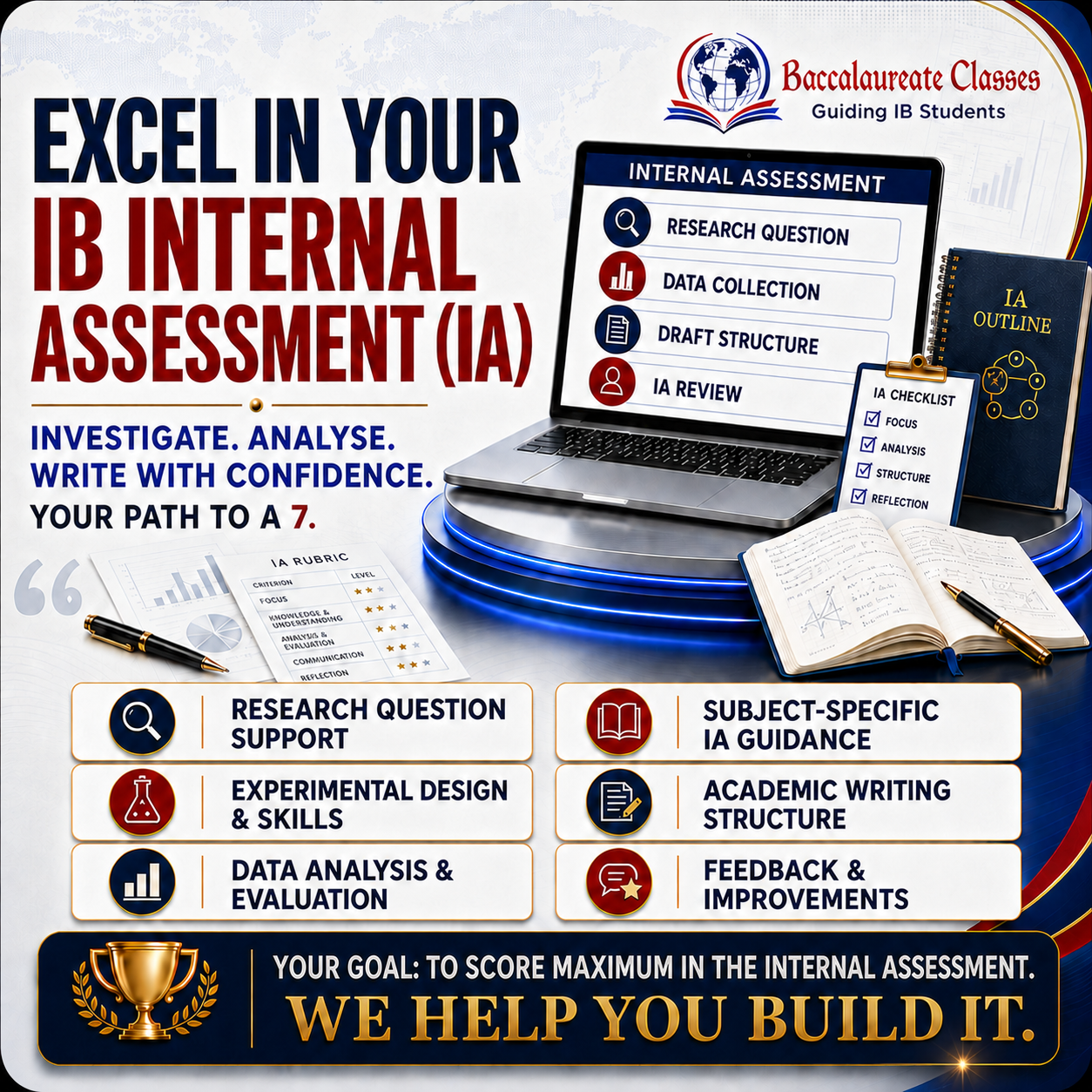
Experienced IB Tutors
Students Mentored
Countries Served
Scored a 6 or Above
IB DP Success Rate
Why Students & Parents Choose Baccalaureate Classes
Complete IB
Subject Support
IA, EE & TOK
Guidance
Regular Progress
Tracking & Feedback
24/7 Academic
Support
Expert IB Tutors with
Global Experience
What Is the IB DP Internal Assessment (IA)
- The Internal Assessment (IA) is a compulsory component of many IB Diploma Programme (DP) subjects and contributes directly to a student's final subject grade.
- It enables students to apply subject knowledge through independent investigation, research, analysis and evaluation while exploring topics beyond the scope of traditional examinations.
- Depending on the subject, students may conduct scientific investigations, explore mathematical concepts, analyse contemporary economic issues, undertake business research or complete subject-specific inquiries.
- Strong Internal Assessments go beyond demonstrating subject knowledge. They effectively address assessment criteria, reflect independent thinking and showcase analytical, evaluative and academic communication skills.
- At Baccalaureate Classes, we help students understand how the IB evaluates Internal Assessments while developing the skills required to meet assessment criteria, satisfy examiner expectations and maximise IA performance.
Why the IB DP Internal Assessment Matters
- The Internal Assessment contributes directly to the final grade in many IB DP subjects, making it an important component of overall performance in the Diploma Programme.
- It provides students with an opportunity to demonstrate skills that extend beyond subject knowledge, including independent research, critical thinking, analysis, evaluation and academic communication.
- Unlike traditional examinations, the IA allows students to investigate a topic in greater depth while applying subject knowledge to meaningful and often real-world contexts.
- The IA is evaluated using carefully developed assessment criteria that reward the quality of research, analysis, evaluation and communication rather than the completion of a task alone.
- Strong performance in the Internal Assessment can strengthen overall subject achievement while helping students develop academic skills that remain valuable beyond the IB Diploma Programme.
How the IB Evaluates Internal Assessments
Many students invest considerable time researching, writing and refining their Internal Assessment but overlook the factors that ultimately determine how marks are awarded. Understanding how the IB evaluates Internal Assessments can help students develop work that aligns more effectively with assessment criteria and examiner expectations.
- Internal Assessments are evaluated using carefully developed subject-specific assessment criteria designed to reward research, analysis, evaluation and academic communication.
- The IB assesses the quality of a student's investigation and reasoning rather than simply the completion of a project or assignment.
- High-scoring Internal Assessments typically demonstrate independent thinking, strong subject understanding, critical analysis and effective communication of ideas.
- Although teachers initially assess many Internal Assessments, the IB uses moderation procedures to ensure that assessment criteria are applied consistently across schools worldwide.
- Students who understand assessment criteria, examiner expectations and moderation standards are often better positioned to maximise their performance in the IB DP Internal Assessment.
Common Challenges Students Face During the IB DP Internal Assessment
- Selecting a focused topic that supports meaningful research, analysis and evaluation
- Developing a clear research question aligned with subject requirements
- Moving beyond description to demonstrate critical thinking and evaluation
- Understanding assessment criteria and examiner expectations
- Balancing the IA alongside coursework, examinations and university applications
What It Takes to Excel in the IB DP Internal Assessment
- Independent thinking that demonstrates intellectual curiosity and engagement
- Meaningful analysis and evaluation supported by relevant evidence
- Strong subject understanding applied in appropriate contexts
- Effective fulfilment of assessment criteria and examiner expectations
- Clear academic communication that reflects academic integrity
How Our IB IA Tutors Support Students
- Provide structured guidance from topic selection to final submission
- Help students refine their ideas, research questions and investigation plans
- Offer personalised feedback to strengthen analysis, evaluation and academic writing
- Identify areas for improvement and help students address them effectively
- Support students throughout the IA process while upholding academic integrity
Whether you are planning your Internal Assessment, developing your investigation or refining your final draft, our experienced IB tutors provide personalised guidance and constructive feedback to help you produce a stronger and more academically rigorous IA.
Your Roadmap to Success in the IB DP Internal Assessment
- 1. Topic Selection
Select a focused and appropriate topic that supports meaningful research, analysis and evaluation. - 2. Research Question Development
Develop a clear and well-defined research question aligned with subject requirements. - 3. Planning and Preparation
Create a structured plan for conducting research, collecting evidence and organising ideas. - 4. Research and Investigation
Gather relevant information, conduct investigations and explore the topic in sufficient depth. - 5. Analysis and Evaluation
Interpret findings critically and develop well-supported analysis and evaluation. - 6. Writing and Communication
Present ideas clearly using appropriate academic conventions and subject-specific terminology. - 7. Review and Refinement
Refine the investigation, strengthen arguments and address areas for improvement. - 8. Final Submission
Complete final checks and submit a polished Internal Assessment with confidence.
Resources Used by Our IB IA Tutors
- IB subject guides and assessment criteria to ensure alignment with official IA requirements
- Examiner reports that provide valuable insights into common strengths and areas for improvement
- Subject-specific textbooks and academic reference materials that strengthen conceptual understanding
- Research journals, academic databases and credible sources that support high-quality investigations
- Statistical data, case studies and real-world evidence relevant to individual IB DP subjects
- Academic writing frameworks that help students communicate ideas in a clear and structured manner
- Research methodologies and investigation techniques appropriate for different subject areas
- Personalised feedback and subject-specific guidance tailored to each student's Internal Assessment
At Baccalaureate Classes, we combine official IB resources with personalised academic support to help students develop stronger investigations, more effective analysis and higher-quality Internal Assessments.
Personalised Online IB Tutoring Beyond IA
A strong IB Internal Assessment requires more than completing a draft; students must demonstrate clear research thinking, sound subject knowledge, accurate analysis and meaningful evaluation. Alongside focused IB IA guidance, Baccalaureate Classes provides structured online IB tutoring across DP, MYP and PYP, helping students strengthen concepts, improve assessment skills and build confidence throughout their IB journey. Whether students need support with Chemistry IA data analysis, Economics IA commentary, Maths IA modelling or Psychology IA evaluation, our experienced IB tutors provide personalised guidance that connects IA success with stronger overall academic performance.
How to Find the Right IB Tutor at Baccalaureate Classes
Connect to Us
Explain Your Requirement
Get Matched with the right IB Tutor
Attend a Free Demo Session
Choose a Package
Make Payment & Start the Classes
Supporting Students From Leading IB Schools Worldwide

India

United States

United Kingdom

Germany

Singapore

Dubai

Hong Kong

Australia

Norway

Sweden

Austria
Meet Our IB Tutors

Mr. Nishit
IB DP Mathematics and Physics Tutor
Mr. Nishit has tutored IB DP Mathematics and Physics full time since 2012. He supports Maths AA and AI and Physics at HL and SL, with an emphasis on clear reasoning and independent problem-solving.
View Profile
Mr. Parveen
IB DP Economics and Business Management Tutor
Mr. Parveen teaches IB DP Economics and Business Management through conceptual explanations and current practical examples to support focused examination preparation.
View Profile
Mr. Nitin
IB and IGCSE Chemistry Tutor
Mr. Nitin teaches IB Chemistry at HL and SL and Cambridge IGCSE Chemistry. With a particular focus on physical chemistry, his structured lessons connect chemical concepts and real-world applications.
View Profile
Ms. Komal
IB and IGCSE Chemistry Tutor
Ms. Komal brings a master's degree in Organic Chemistry to her IB and IGCSE teaching. Her explanations make complex chemical ideas more accessible, helping students develop understanding through clear examples and an encouraging learning environment.
View Profile
Ms. Sonali
IB and IGCSE Chemistry Tutor
Ms. Sonali draws on a background in organometallic chemistry and experience spanning research and teaching. Her IB and IGCSE lessons encourage students to understand chemical principles deeply and apply them with scientific confidence.
View Profile
Mr. Siddharth
IB DP, MYP and IGCSE English Tutor
Mr. Siddharth teaches English across IB DP, MYP and IGCSE. With postgraduate study in English and extensive language-teaching experience, he helps students develop reading, writing and speaking skills alongside an appreciation of literature.
View Profile
Ms. Manjula
IB DP, AP and IGCSE Computer Science Tutor
Ms. Manjula combines Computer Science teaching with academic leadership and educational technology. Her approach encourages critical thinking and practical problem-solving, drawing on experience across IB, Cambridge and AP education.
View Profile
Ms. Vanshika
IB Spanish Tutor
Ms. Vanshika teaches Spanish to learners of different ages and proficiency levels. Her lessons develop conversation, listening, reading and writing, drawing on experience in language training, curriculum development and cross-cultural communication.
View Profile
Ms. Hiba
IB French Tutor
Ms. Hiba creates personalised online French lessons around each learner's proficiency and goals. Her teaching combines practical communication, cultural context and interactive activities, supported by a teaching qualification in French from the Universite de Montreal.
View Profile
Ms. Nimita
IB DP Computer Science and Digital Society Tutor
Ms. Nimita teaches IB DP Computer Science and Digital Society. Her expertise includes programming, databases, assessment design and emerging technologies, helping students connect technical skills with inquiry and the ethical questions surrounding digital systems.
View Profile
Ms. Rinchi
IB MYP Integrated Sciences Tutor
Ms. Rinchi teaches MYP Biology and Integrated Sciences, drawing on a background in Biotechnology and Education. Her lessons connect scientific ideas with practical applications and support inquiry, assessment preparation and interdisciplinary understanding.
View Profile
Ms. Tamana
IB MYP and IGCSE English Tutor
Ms. Tamana teaches MYP and IGCSE English with an emphasis on literary interpretation and clear expression. Her inquiry-led lessons encourage students to question texts, develop their own analysis and communicate ideas with confidence.
View Profile
Ms. Deepali
IB and IGCSE Biology Tutor
Ms. Deepali teaches Biology across international curricula. Her lessons use inquiry and logical reasoning to explore biological ideas, drawing on her background in Botany, Zoology and Education to support understanding of the living world.
View Profile
Ms. Vidya
IB PYP, MYP and IGCSE Tutor
Ms. Vidya teaches across PYP, MYP and IGCSE, adapting lessons to individual learning needs. Her approach combines conceptual understanding, creative activities and practical applications to help students connect ideas with everyday situations.
View Profile
Ms. Namrata
IB PYP and MYP Educator
Ms. Namrata plans PYP and MYP learning through inquiry, conceptual connections and reflection. She uses real-life contexts and purposeful activities to help students ask better questions, think independently and take ownership of their learning.
View Profile
Ms. Tanya
IB PYP Tutor
Ms. Tanya develops inquiry-led PYP learning through stories, hands-on activities and real-world connections. Her personalised approach encourages children to communicate their thinking, reflect on their learning and become more confident, independent learners.
View Profile
Ms. Pallavi
IB PYP and MYP Tutor
Ms. Pallavi combines PYP and MYP teaching experience with curriculum coordination and learning design. Her approach connects inquiry, conceptual learning and differentiated instruction, encouraging students to explore ideas and develop reflective, independent thinking.
View Profile
Ms. Aparajita
IB DP Psychology Educator | TOK Facilitator
Ms. Aparajita is an experienced international educator and academic leader with over 12 years of teaching experience across reputed international schools in India and abroad.
View ProfileSome of the Top Universities Our IB Students Secured Admission














Some of Our Widely Chosen IB Online Tutoring Services
IB Maths Tutoring
Clinch a 7 with the support of our expert IB maths tutors in analysis and approaches or applications and interpretation. Our teachers precisely know how to strategise IB mathematics tutoring to obtain the optimum result by a student.
IB Physics Tutoring
Our highly experienced and trusted IB physics tutors explain the tough concepts in such a way that students can solve applications based numericals successfully. We strongly believe that with the prudent IB physics tutoring and right practice our students can definitely get a 7.
IB Chemistry Tutoring
Learn the mystery of chemicals and compounds with our adept IB chemistry tutors. During IB chemistry tutoring sessions, our teachers explain the mysterious physical and chemical behavior of compounds in an easy way to ignite the learning curiosity in the students.
IB Biology Tutoring
Understand the complex theoretical concepts of zoology and botany through our IB biology tutoring in an easy manner. In our online biology tutoring classes our teachers guide the students how to write the answers using correct terminologies as per IB requirement.
IB English Tutoring
Baccalaureate Classes has a team of highly experienced, world-class IB English tutors for the IB English Language and Literature help subject. Our English teachers help students with the analysis of different ranges of text-types as well as literacy forms of various style and cultures.
IB Economics Tutoring
Master the concepts of macroeconomics and microeconomics with our IB economics tutors in a fun way. Throughout IB online economics tutoring sessions our educators make students solve worksheets and past papers to make the learning result-oriented.
Student Success Stories
How to Get Started with Online IB IA Tutor
- Contact us via website, phone or WhatsApp
- Schedule a consultation with an IB mentor
- Choose your subject expert
- Book a trial session
- Start regular lessons with flexible scheduling
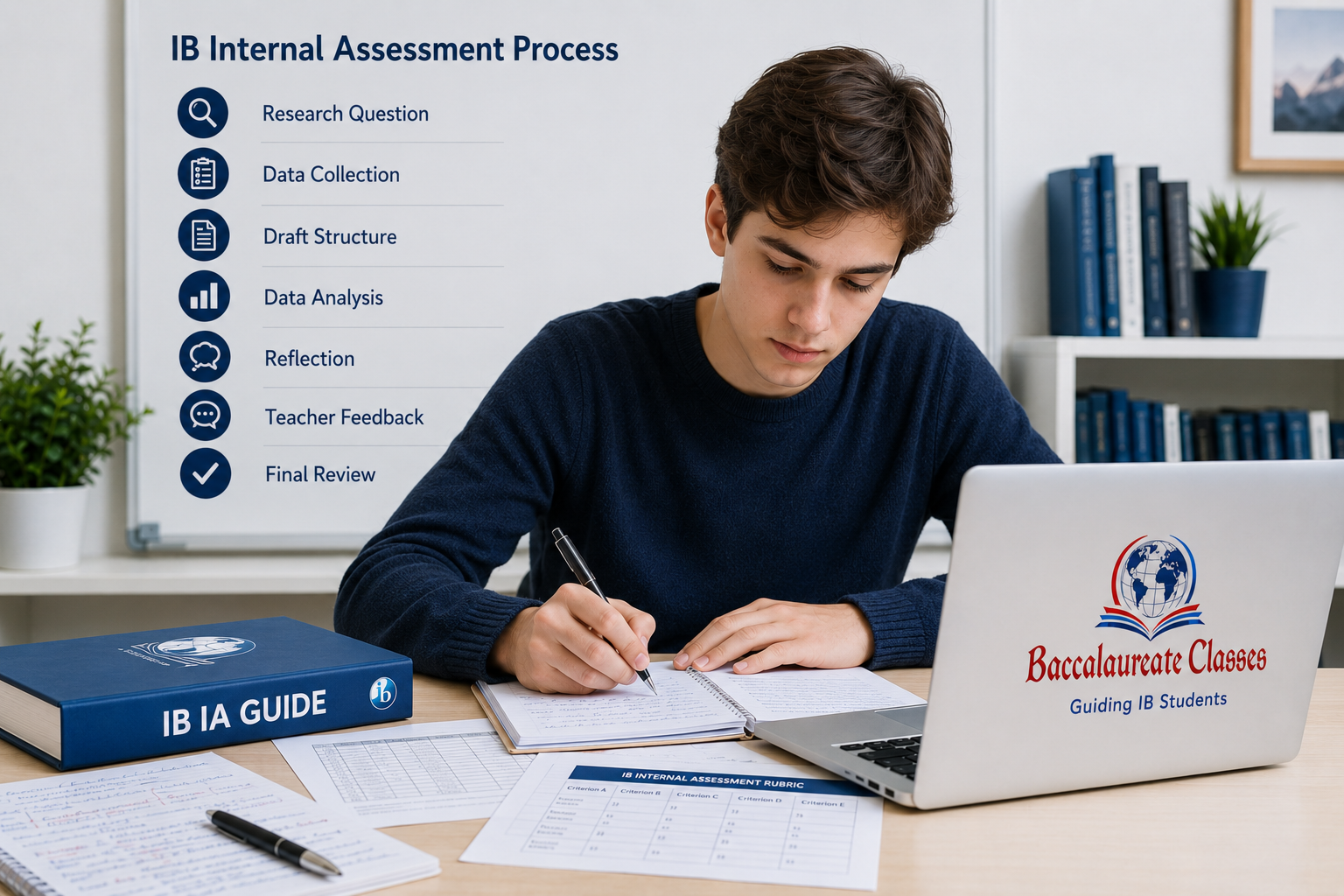
Looking for an IB Internal Assessment (IA) Tutor in Your City?
Our experienced IB Internal Assessment (IA) tutors provide personalised online tutoring to students studying the International Baccalaureate across the world. Whether you are based in Asia, Europe, the Middle East or North America, explore our dedicated location pages to find IB Internal Assessment (IA)Internal Assessment (IA) oring tailored to your city and educational requirements.