
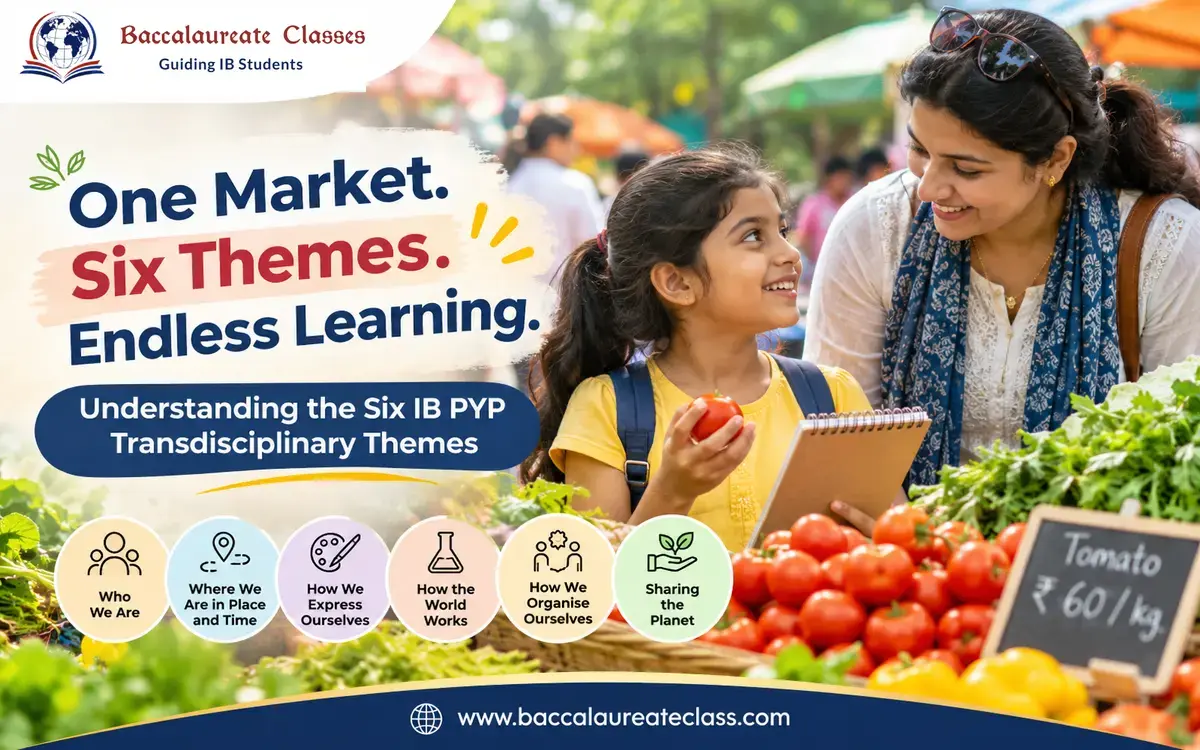
On a Sunday morning, a mother takes her eight-year-old daughter to the local vegetable market. While shopping, the child notices that tomatoes are almost twice as expensive as they were the previous week.
“Why have the prices changed when the tomatoes look exactly the same?”
The conversation soon moves towards rainfall, farming, transportation, demand and supply, and the livelihoods of farmers.
Without opening a textbook, the child has already encountered elements of mathematics, science, economics and social studies.
Children rarely separate their curiosity into subjects. This is precisely the thinking behind the IB PYP transdisciplinary themes, which bring different areas of learning together through experiences that children can relate to.
What Does Transdisciplinary Learning Actually Mean?
For parents who are new to the International Baccalaureate Primary Years Programme (IB PYP), the term ‘transdisciplinary’ can initially sound complicated. However, the philosophy behind it is quite simple.
Knowledge does not exist in isolation, so learning should not always happen in isolation either.
Consider a child learning about fractions. Understanding halves and quarters through textbook exercises is important. However, when the same child adjusts a family recipe for six people instead of three, mathematical understanding acquires a practical purpose.
The PYP creates opportunities for such connections through six transdisciplinary themes that frame a school's programme of inquiry.
Within these themes, schools develop Units of Inquiry (UOIs) through which children investigate significant ideas, develop subject knowledge and apply their understanding to unfamiliar situations.
Subject-specific learning remains important. The difference lies in helping children recognise how different subjects contribute to understanding a larger idea.
Exploring the Six IB PYP Transdisciplinary Themes Through Everyday Life
1. Who We Are – Understanding ourselves and others
At the vegetable market, the child notices that different families purchase different ingredients. Some choose vegetables familiar to their cultural traditions, while others make decisions based on personal preferences, availability or affordability.
This observation could lead to conversations about family traditions, cultural identity, personal choices and well-being.
Under Who We Are, learners explore identity, relationships, values and human development.
A classroom inquiry might involve children interviewing family members about traditional meals and discovering how food connects people to their cultural identities.
The learning extends beyond identifying differences. Children begin to appreciate why people make different choices and how individual experiences shape their perspectives.
2. Where We Are in Place and Time – Understanding journeys and change
Have you ever asked your child where the food on their plate comes from?
A tomato purchased locally may have travelled hundreds of kilometres before reaching the market.
Tracing this journey introduces children to geography, transportation and the connections between different communities.
The inquiry could extend further. How did people preserve food before refrigerators? How have farming practices changed over generations? Why did certain foods travel from one region to another?
Through Where We Are in Place and Time, children explore histories, journeys, discoveries and relationships between people and places.
Comparing past and present experiences helps learners understand how human decisions and developments shape the way we live today.
3. How We Express Ourselves – Understanding the power of communication
Two vendors sell similar vegetables, yet one attracts considerably more customers.
What makes the difference?
Children might observe colourful displays, handwritten signs, persuasive language and the ways vendors interact with customers.
These observations provide an interesting starting point for exploring communication.
Under How We Express Ourselves, learners investigate how people communicate ideas, experiences, beliefs and creativity.
In the classroom, children could design advertisements for locally grown produce, experimenting with vocabulary, colours, illustrations and persuasive techniques.
They could then discuss whether their advertisements communicate accurate information or create misleading impressions.
Such experiences develop creativity alongside critical thinking and responsible communication.
4. How the World Works – Understanding scientific connections
Why do some vegetables remain fresh for longer than others? Why does excessive rainfall sometimes affect agricultural production?
Questions like these naturally introduce scientific inquiry.
Children might investigate the conditions required for plant growth, compare food storage methods or observe how different environmental conditions influence fresh produce.
Under How the World Works, learners explore scientific principles, natural systems and technological developments.
For instance, investigating why refrigeration slows food spoilage allows children to connect scientific knowledge with familiar household practices.
Science becomes a means of explaining everyday observations rather than simply remembering definitions.
5. How We Organise Ourselves – Understanding systems and communities
A vegetable market depends on more people than the customers and vendors visible to us.
Farmers grow the produce, transporters deliver it, wholesalers distribute it and local authorities may regulate market operations.
Under How We Organise Ourselves, learners examine human-made systems, organisations, economic activities and collective decision-making.
Children could create a simple supply chain diagram showing how vegetables travel from farms to consumers.
They might also calculate purchasing costs, compare selling prices and investigate what happens when one part of the system is disrupted.
The original question about rising tomato prices now becomes an opportunity to understand how interconnected systems influence everyday life.
6. Sharing the Planet – Understanding our collective responsibilities
At the end of the day, some vendors are left with unsold vegetables. Customers leave carrying plastic bags, and discarded produce accumulates around the market.
What happens to these resources? Could some of this waste be prevented?
Under Sharing the Planet, learners explore sustainability, shared resources, interconnected living systems and responsibilities towards others.
Children might investigate food waste, explore composting or compare reusable and disposable packaging.
More importantly, they could identify a small, realistic action, such as encouraging their families to carry reusable shopping bags.
The inquiry connects environmental understanding with responsible decision-making.
Where Do Mathematics, English and Other Subjects Fit In?
A common concern among PYP parents is whether inquiry-based learning provides sufficient academic depth.
Consider a class investigating the question: How does food reach our community?
The learning opportunities could include:
- Mathematics: Comparing prices, calculating expenses, measuring quantities and interpreting graphs.
- Language: Conducting interviews, reading informational texts and writing reports.
- Science: Investigating plant growth, seasonal changes and food preservation.
- Social Studies: Exploring occupations, trade, transportation and community systems.
- Arts: Designing informative packaging and awareness posters.
- Personal, Social and Physical Education: Exploring nutrition, cooperation and responsible choices.
Depending on the central idea, this investigation might sit primarily under one transdisciplinary theme. Schools do not need to incorporate every theme or subject into every inquiry.
What matters is that the connections are purposeful and contribute to deeper understanding.
How Baccalaureate Classes Supports Connected Learning
Some children can calculate accurately but struggle to interpret information in unfamiliar contexts. Others may have excellent ideas during discussions but find expressing them in writing challenging.
These gaps become particularly noticeable during transdisciplinary inquiries.
At Baccalaureate Classes, personalised online IB tutoring supports children in strengthening subject-specific skills while making meaningful connections with their classroom learning.
For example, a learner investigating market prices might receive targeted support in creating graphs, interpreting numerical patterns and writing evidence-based conclusions.
Through IB PYP tuition, tutors can also reinforce Approaches to Learning (ATL) skills, particularly research, thinking and communication, while encouraging children to develop their own explanations.
The purpose is not to complete a child's inquiry but to help them become increasingly capable of conducting it independently.
Frequently Asked Questions
1. Are the six transdisciplinary themes the same in every IB PYP school?
Yes, the six overarching themes are shared across the PYP framework. However, schools develop their own units and learning experiences according to their educational contexts.
2. Are traditional subjects still taught in the PYP?
Yes. Subject-specific knowledge and skills remain essential. Transdisciplinary learning provides opportunities to apply them meaningfully.
3. Can parents encourage transdisciplinary learning at home?
Certainly. Everyday experiences such as travelling, cooking, shopping and gardening provide opportunities for questioning, reasoning and making connections.
4. How can I recognise whether my child is developing conceptual understanding?
Notice whether your child can explain why something happens, connect ideas from different experiences and apply previous learning to a new situation.
The next time your child asks why something has become more expensive, resist the temptation to offer an immediate answer. Explore the question together.
Sometimes, a conversation at a vegetable market can reveal just how interconnected learning really is.
Help your child build academic confidence and meaningful connections through personalised PYP learning support at Baccalaureate Classes.