
Imagine two children learning about water.
The first can name the stages of the water cycle, list sources of water and identify ways to conserve it.
The second wonders why some communities struggle to access clean water, investigates household consumption and questions how individual choices affect shared resources.
Both children are acquiring knowledge. But are they developing the same depth of understanding?
This is where PYP central ideas and lines of inquiry transform learning into a meaningful process of discovery. Within the International Baccalaureate Primary Years Programme (IB PYP), learning is designed to encourage children to question, investigate, connect and apply their understanding beyond the classroom.
1. A central idea: the understanding behind the learning
Imagine opening your child's school planner and reading:
The choices we make influence the sustainability of our planet.
You might wonder why the teacher has written a statement instead of a topic such as pollution or natural resources.
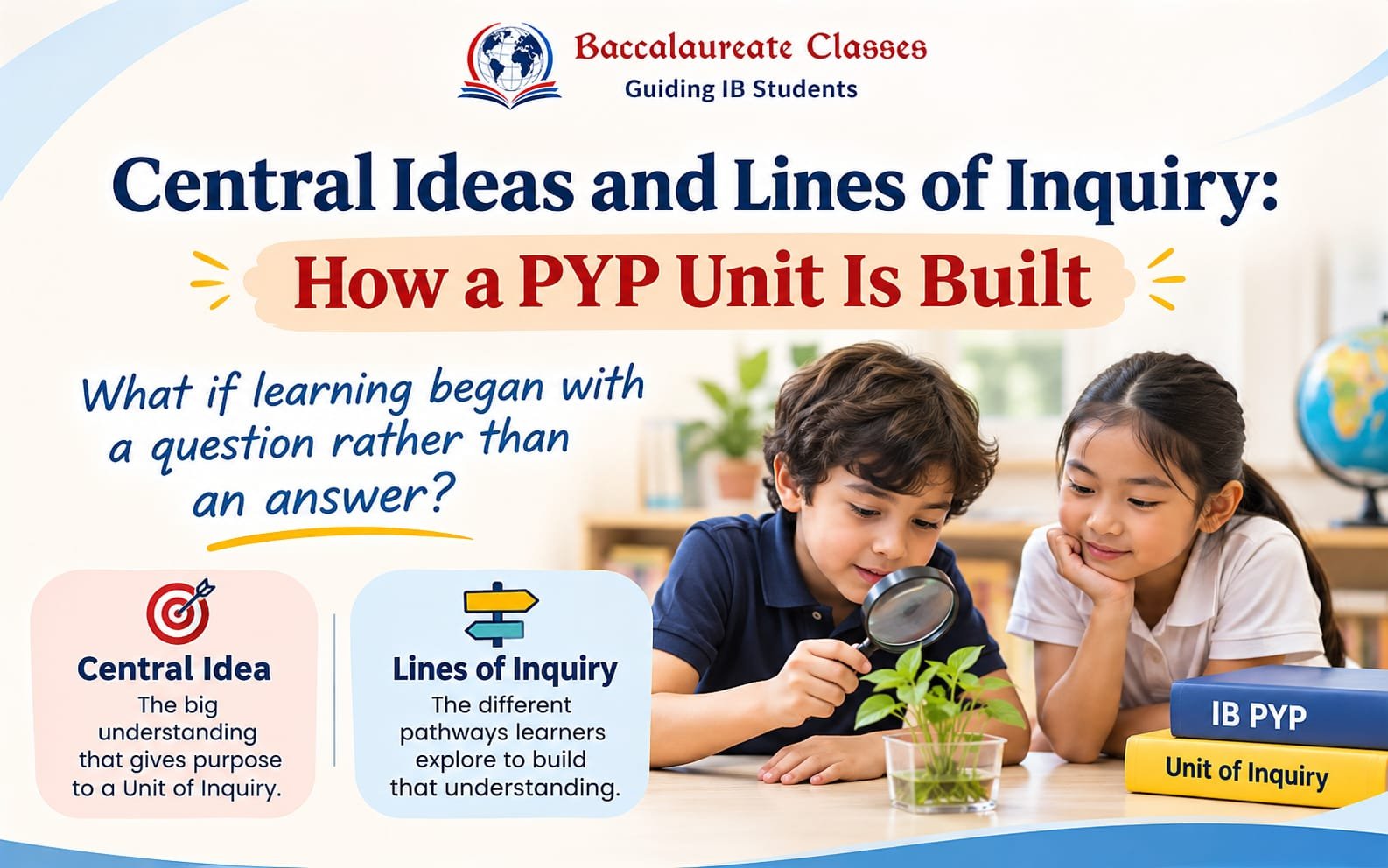
This statement is a central idea — a broad conceptual understanding that gives purpose and direction to a Unit of Inquiry (UOI).
Consider the following examples:
| Topic | Possible central idea |
|---|---|
| The human body | Body systems work together to support well-being. |
| Communities | Communities develop systems to meet shared needs. |
| Technology | Innovations influence how people live and interact. |
| Natural resources | Human choices influence the sustainability of shared resources. |
Notice how each central idea encourages thinking beyond factual knowledge.
A child exploring communities might initially learn about hospitals, schools and transport systems. However, the deeper understanding emerges when the child recognises why communities need organised systems and how these systems are interconnected.
This understanding can then be transferred to unfamiliar communities across the world.
The central idea therefore becomes the intellectual destination of an inquiry rather than a statement children simply memorise.
2. Lines of inquiry: different pathways towards understanding
If the central idea represents the destination, lines of inquiry represent the pathways learners can explore to reach it.
Consider a unit about healthy living.
Central idea: Everyday choices influence our physical, social and emotional well-being.
Possible lines of inquiry:
- Factors that contribute to well-being.
- Connections between everyday choices and health.
- Individual responsibility for personal well-being.
Through the first line, children might investigate nutrition, rest, relationships and physical activity.
Through the second, they could explore how different habits influence concentration, energy and emotional well-being.
Through the third, they might reflect on their routines and identify meaningful changes.
However, inquiry does not stop with teacher-planned learning experiences.
A learner might ask:
- Why do people need different amounts of rest?
- Can friendships influence our well-being?
- How does our environment affect the choices we make?
Such student-generated questions bring agency, curiosity and ownership into the learning process.
While lines of inquiry provide direction, children's questions allow the inquiry to develop in personally meaningful ways.
3. Putting the IB elements into action: an illustrative Unit of Inquiry
Imagine a teacher placing a photograph of a community experiencing water scarcity alongside a photograph of a garden being watered.
Instead of immediately explaining the problem, the teacher asks:
What do you notice? What do you wonder? What connections can you make?
This provocation could introduce the following illustrative unit.
Transdisciplinary theme: Sharing the Planet
Central idea: Human choices influence the availability and sustainability of shared natural resources.
Lines of inquiry:
- The importance and availability of natural resources.
- The impact of human choices on natural resources.
- Individual and collective responsibility for conservation.
Learning through specified concepts
The specified concepts provide different lenses through which learners examine the inquiry.
Connection: How are human activities and natural resources interconnected?
Causation: Why does water scarcity occur?
Responsibility: What responsibilities do individuals and communities have towards shared resources?
These questions encourage learners to move from identifying information towards interpreting relationships and consequences.
Learning across subject boundaries
| Subject | Possible learning experience |
|---|---|
| Science | Investigating the water cycle and freshwater availability. |
| Mathematics | Collecting and interpreting household water-usage data. |
| Language | Reading informational texts and developing evidence-based explanations. |
| Social Studies | Comparing access to water across communities. |
Rather than learning these subjects in isolation, students explore how knowledge from different disciplines contributes to understanding the central idea.
Along the way, children develop Approaches to Learning (ATL) skills, including research, thinking and communication.
They demonstrate the IB Learner Profile attributes of inquirers, thinkers and caring individuals by questioning information, evaluating solutions and considering the needs of others.
Their understanding might inspire them to investigate water wastage at school and propose a conservation initiative.
This is how inquiry can lead to meaningful student action.
4. How can parents recognise conceptual understanding?
Imagine your child returning home with a beautifully presented poster about saving water.
Instead of asking only what marks the poster received, consider asking:
How does saving water in our home connect to the availability of resources in other communities?
The response may reveal more about conceptual understanding than the finished product alone.
A child who identifies connections between consumption, availability and responsibility is beginning to demonstrate understanding beyond factual recall.
Now imagine the same child recognising similar connections while discussing electricity consumption.
This demonstrates transfer of learning — applying an understanding developed in one context to another.
Parents can nurture this process through everyday conversations.
During a supermarket visit, ask how packaging choices affect the environment. While travelling, explore why communities organise transport differently. After reading a story, discuss how different characters perceive the same situation.
Simple questions such as “What makes you think that?” or “Where else could this idea apply?” can encourage reasoning, reflection and conceptual thinking.
Meaningful inquiry does not always require elaborate projects. It can begin with an ordinary experience and a thoughtful question.
5. How can Baccalaureate Classes support this learning journey?
Some children can gather information confidently but struggle to explain how their findings connect to the central idea.
For example, a learner may research renewable energy, prepare detailed notes and identify different energy sources, yet find it challenging to explain how energy choices influence sustainability.
Through personalised IB PYP tutoring, this gap can be addressed using guided questioning and conceptual mapping.
A tutor might encourage the learner to consider:
- What have you discovered?
- What evidence supports your understanding?
- How does your discovery connect to the central idea?
- Can you apply this understanding to another situation?
Similarly, a child who finds data interpretation challenging might benefit from targeted mathematical practice connected to the current inquiry.
At Baccalaureate Classes, personalised online IB PYP tuition can complement school learning by strengthening subject knowledge, conceptual connections and independent thinking.
The objective is not to provide ready-made answers, but to equip learners with the skills and confidence to construct their own understanding.
Frequently asked questions
1. Is a central idea the same as a topic?
No. A topic identifies the content being explored, while a central idea expresses the broader understanding learners develop through that exploration.
2. Do all IB PYP schools use the same central ideas?
No. Schools develop their own programmes of inquiry within the IB PYP framework, considering their learners, contexts and curriculum requirements.
3. Can children ask questions beyond the lines of inquiry?
Yes. Student-generated questions encourage agency and deeper exploration. Teachers help learners connect these questions to the broader purpose of the unit.
4. How can parents support inquiry-based learning at home?
Encourage curiosity, invite explanations, explore different perspectives and help children connect classroom learning with everyday experiences.
The next time your child tells you about a new Unit of Inquiry, try asking not just, “What are you learning?” but also:
“What are you beginning to understand about the world that you did not understand before?”
That is where meaningful conceptual learning becomes visible.
Explore personalised PYP academic support by an IB tutor at Baccalaureate Classes and help your child develop the skills to question, connect, understand and grow.
Visit www.baccalaureateclass.com to enquire about personalised IB PYP tuition.