1. Can Baccalaureate Classes support an IB student anywhere in the USA?
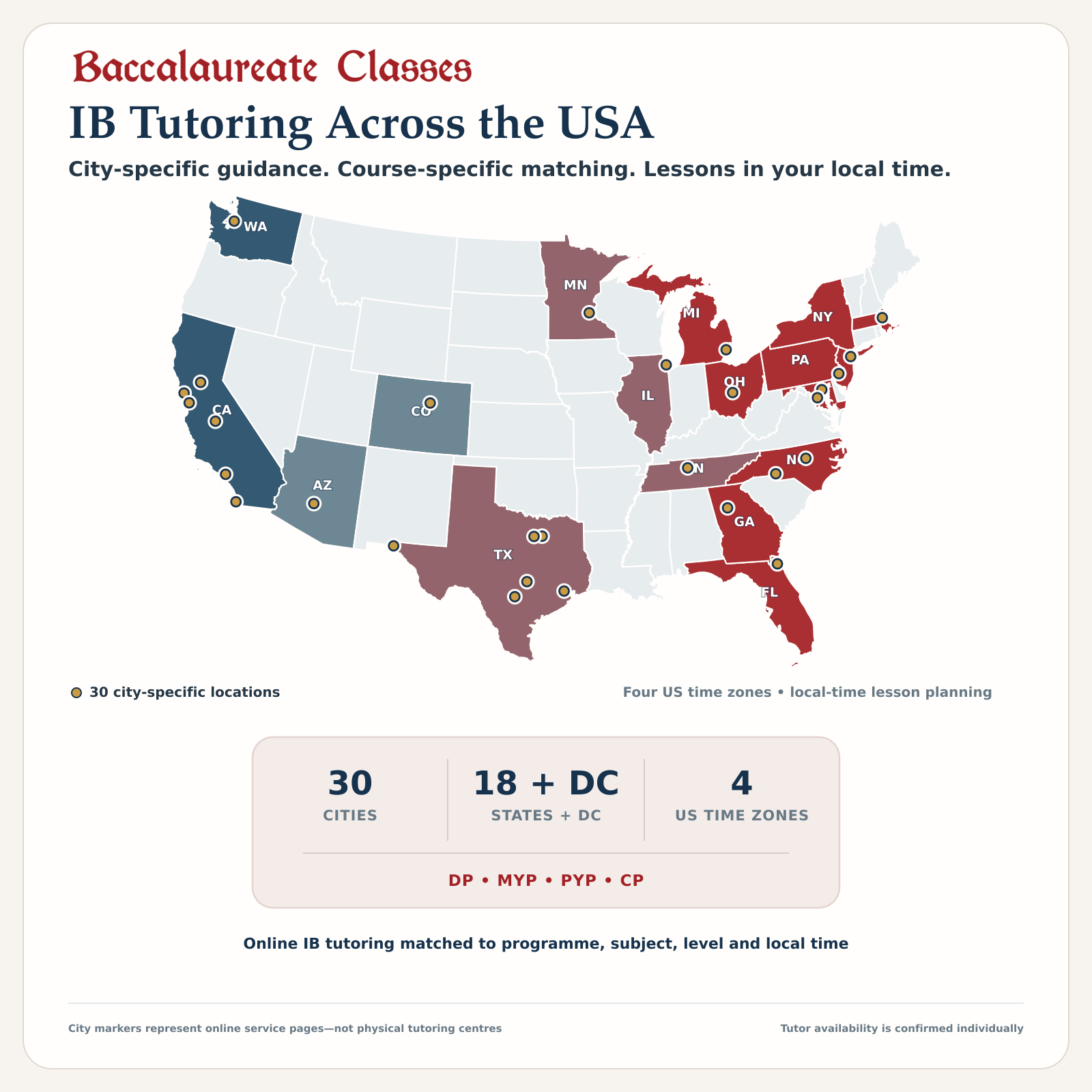
Online support can be arranged across the United States when a suitable tutor is available for the student’s programme, exact course and level. Baccalaureate Classes coordinates the match in the family’s local time and currently organises its USA directory around 30 city markets across 18 states and Washington, DC.
2. How does Baccalaureate Classes manage Eastern, Central, Mountain and Pacific Time?
The consultation records the student’s city, time zone and realistic after-school or weekend windows before availability is checked. Lesson invitations should show the student’s local time. This matters during US daylight-saving changes and in Arizona, where most locations do not change clocks.
3. Can you work with IB students in US public, magnet, charter, private and international schools?
Yes, subject to the required course expertise. Baccalaureate Classes does not assume that all US IB schools follow the same sequence. Matching considers the student’s programme route, district or school calendar, current unit, HL or SL level, internal deadlines and recent work.
4. Can my child receive help with one DP course without enrolling in full-Diploma support?
Yes. A student taking one or more individual DP courses can request focused support for the relevant subject and level. Baccalaureate Classes first identifies whether the need concerns content, application, exam technique or coursework planning rather than recommending unnecessary whole-Diploma coordination.
5. How is tutoring aligned with a quarter, semester or trimester calendar?
The tutor should review the unit being taught, the school’s grading period, upcoming assessments and the next IB requirement. Baccalaureate Classes uses those dates to define the first priority and review point, so tutoring follows the student’s actual US school calendar rather than a generic global timetable.
6. Can an American student study an IB course and an AP course with Baccalaureate Classes?
Potentially, when appropriate subject expertise is available. The two curricula must remain academically separate: an IB objective is taught through its IB course expectations and an AP objective through the relevant AP framework. The matching request should name each course explicitly.
7. How do you distinguish Mathematics AA, Mathematics AI and IB Physics when matching a tutor?
Baccalaureate Classes asks for the exact course, HL or SL level, current topic and a recent attempted task. AA and AI place different emphasis on mathematical thinking and use, while Physics requires conceptual modelling, calculation and scientific communication. A generic “IB Maths” or “IB Science” label is not considered a complete match.
8. What support is appropriate for an IA, Extended Essay or TOK task?
A Baccalaureate Classes tutor may explain requirements, question the student’s reasoning, help plan a manageable process and give formative feedback within academic-integrity boundaries. The research choices, evidence, analysis and submitted language must remain the student’s. Tutoring must not become authorship or assessed-work completion.
9. How would Baccalaureate Classes prepare a US student for IB examinations?
Preparation begins with evidence from attempted questions rather than an arbitrary volume of past papers. The tutor separates missing knowledge from weak transfer and unclear communication, then combines concept repair, mixed practice, error analysis and timed work appropriate to the course and level.
10. How many IB tutoring lessons should a student take each week?
Baccalaureate Classes does not prescribe one frequency for every learner. A sensible recommendation depends on the size of the gap, HL or SL workload, school-week pressure, next deadline and the student’s capacity for independent practice. Start with one defined objective and review the cadence using evidence.
11. What progress should parents expect Baccalaureate Classes to report?
Progress should be described through the agreed academic priority—for example fewer repeated algebra errors, stronger independent starts, clearer Physics explanations or better timed-paper decisions. Attendance alone is not evidence of improvement and Baccalaureate Classes should not guarantee an IB grade.
12. Can tutoring raise a predicted IB grade at a US school?
Tutoring may improve understanding, consistency and assessment performance before a school makes its prediction. However, the school controls its predicted-grade process. Baccalaureate Classes can support the underlying academic performance but cannot promise or issue a predicted grade.
13. Will an IB score automatically earn college credit in the United States?
No. US colleges and universities set their own current rules by subject, HL or SL level and score, and policies can change. Baccalaureate Classes can help a student learn the course but families should verify credit or placement directly on each institution’s official website.
14. Is Baccalaureate Classes an IB World School or part of the International Baccalaureate?
No. Baccalaureate Classes is an independent online tutoring provider. It does not award the IB Diploma, replace the student’s authorised school or claim affiliation with the International Baccalaureate. Its role is supplementary academic support.
15. What information should a US family provide before requesting an IB tutor?
Send the student’s programme, grade, exact course, HL or SL level, city and time zone, current unit, recent attempted work, next assessment or coursework deadline and suitable lesson windows. Baccalaureate Classes uses this academic map to assess tutor fit and propose a focused first objective.